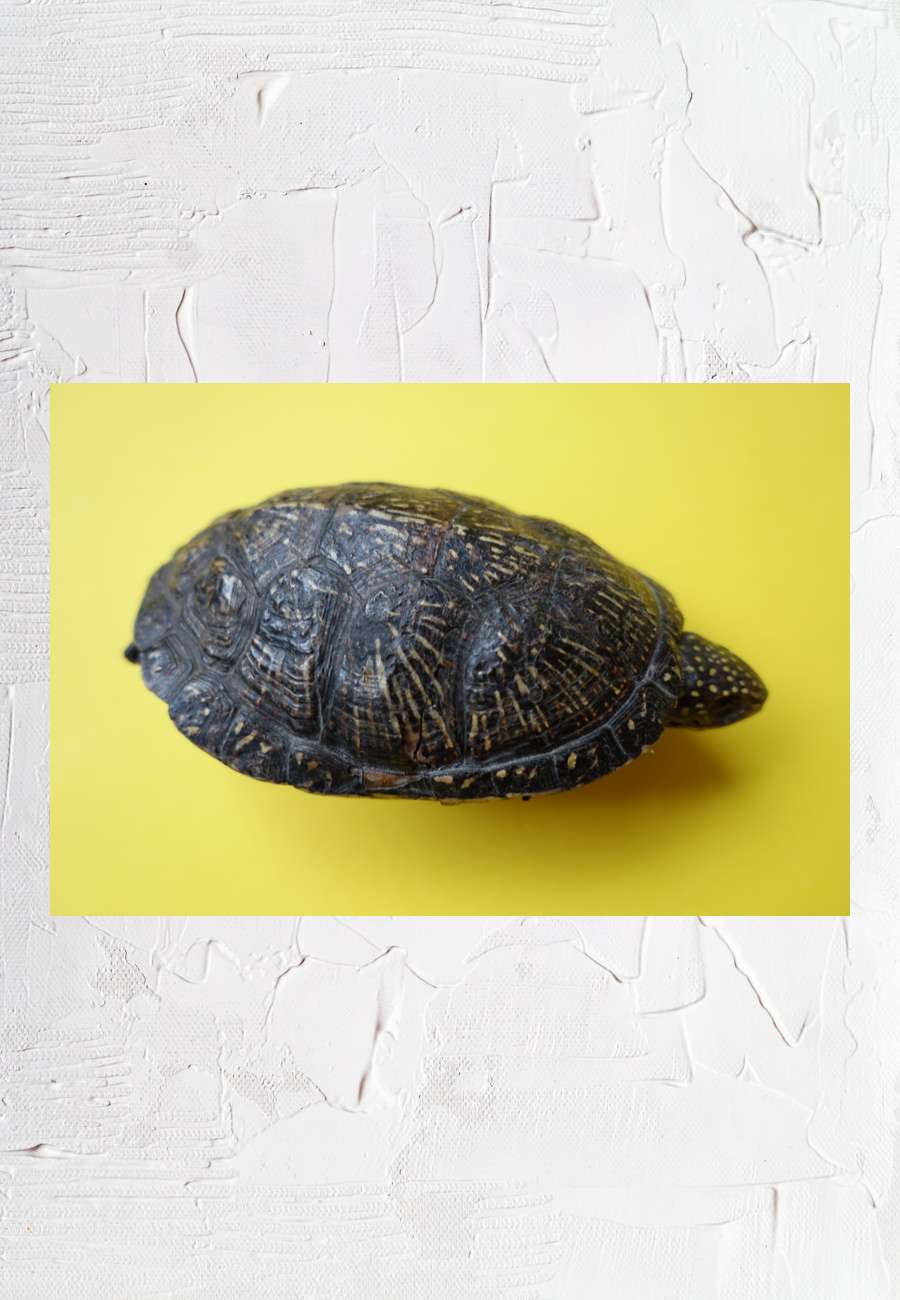
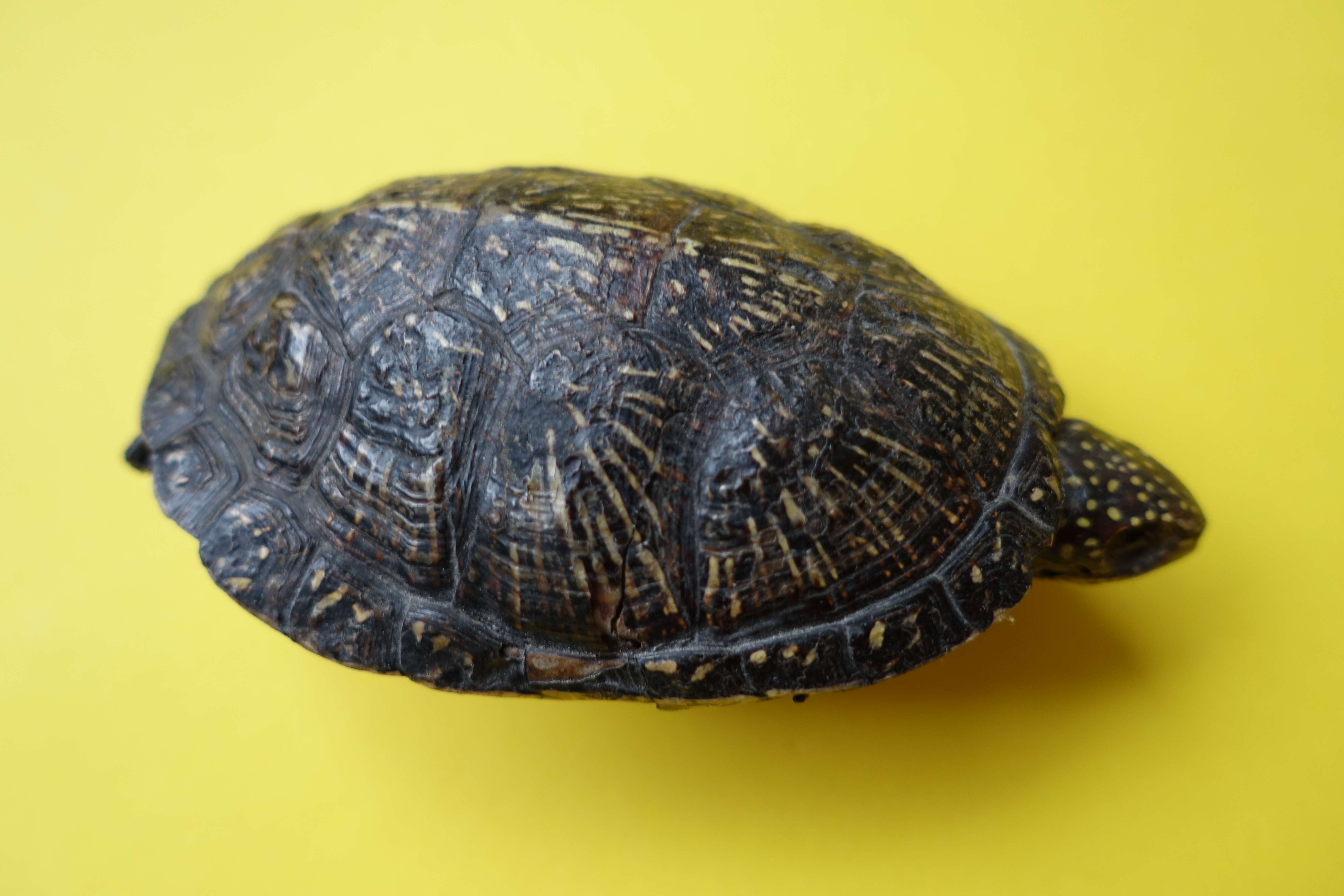
European turtle turtle (Emys Orbicularis), well prepared and easily recognizable by the fine radiation pattern and the striking yellow dots, size 11 cm. They become up to 70 years old (in exceptional cases up to 100 years), lay 7-11 eggs (2-3 clutch per year), the winter rest is 3-5 months. This, according to the "Roter List" (the IUCN / International Union for Conservation of Nature, with observer and consultant status at the United Nations), the endangered species was previously widespread in Germany. However, they were already very popular with monks in the Middle Ages - declared a fish - as a fasting dish (in addition to beavers and thick carp) and as a result. Today they are only at home in Germany in very few places and there in rather small populations. In the meantime there are at least resettlement projects, e.g. in Mecklenburg-Western Pomerania or the protection project with rearing station (Rhinluch, Linum) in Brandenburg (including the Ministry of Agriculture, Environment and Nature Conservation). Approximately 860 swamp turtles could be released there by 2023. The only walk -in free area in Germany is located in the Uckermark (Blumberger Mühle, approx. 90 km northeast of Berlin). The "AG Swull turtle" founded on private initiative cooperates with the Hessian Ministry of the Environment and some Zoos,
Among others with the Nuremberg Tiergarten. In the meantime, the Wildpark Hundhaupten in Franconian Switzerland (the district of Forchheim) was added, also the Bayreuth Röhrensee Tierpark with a small outdoor terrarium, initially with 3 animals (by supporting the Bayreuth terrarium club), as well as the hope of increasing and release. Also very remarkable is the engagement of the reception center for reptiles Munich e.V., under the direction of Dr. Markus Baur. The Heinz Sielmann Foundation (Search: Sielmann) maintains an exemplary protection program in the northern Brandenburg, primarily supported by donations. Overall, this also applies similar to the NABU Nature Conservation Association, e.g. in the Auen area on the Oberrhein (Rhineland-Palatinate) and on the Steinhuder Meer (Lower Saxony), even cross-border on the French side of the Rhine (EU-Interreg project "Spurf turtle without limits"), now expanded to include the "EMYS-R" project (in addition with poles and Lithuania). The University of Landau and Sea live in Speyer are also involved. There is also a strong cooperation between the Donau-Auen National Park and the Schönbrunn Tiergarten (Vienna), including sponsorships. The Eggstätt-Hemhofer Lake District nature reserve is also considered a habitat. There are aspirations to support the poultry turtle population by breeding and release. This type was common in the Seoner lakes, but has long been extinct. During an exhibition management in the Seeon monastery (including scriptorium), interesting information about the book painting of the Middle Ages was obtained: Animal colorants were obtained from the bile of swamp turtles. Since the European swamp turtle is particularly important to me, I support several of the projects mentioned. The genus of the European Spurf turtle also includes the Sicilian poultry turtle ((Emys Trinacris), which was only recognized in 2005 as an independent way.
[hint: this is an automatic translation from German]
| Category: artefact
| Material: Schildpatt Präparate
| Country of origin:
Bavaria, Germany
|
Similar pieces
 .
.
|
A visually similar exhibit of the collection is#6854 - artefact |
 .
.
|
The object of the collection with nearest place of origin in Bavaria, Germany is #6591 - Commodities . |